 "For to kill is the great law set by nature in the heart of existence! There is nothing more beautiful and honorable than killing!"—Guy de Maupassant.
At MUBI, Adrian Curry has curated a stunning gallery of posters for François Truffaut's The Bride Wore Black (La mariée était en noir, 1968) on the occasion of the film's re-release at New York's Film Forum. Also at MUBI, Daniel Kasman offers an object lesson in visual acuity by astutely comparing an Econolite train motion lamp (with "General" engine) as it appears in both The Bride Wore Black and Wim Wender's The American Friend (1977). Then, of course, David Hudson has rounded up a few key reviews from the Forum run, most notably my San Francisco Film Critics Circle colleague Fernando Croce's burnished piece for Slant.
 Here on the West Coast, The Bride Wore Black showed up in the Pacific Film Archive's Enduring Allure retrospective of the films of Jeanne Moreau, which is where I caught up with Truffaut's adaptation of Cornell Woolrich's 1940 novel. PFA characterized The Bride Wore Black as Truffaut's alleged homage to Alfred Hitchcock "treated in the manner of Renoir." The San Francisco Film Society followed suit less than a week later with a brief run of a new 35mm print of The Bride Wore Black at New People Cinema, where I attended their first screening on Friday, December 16, 2011, specifically to hear Eddie Muller engage Laura Truffaut in an onstage conversation before her father's film.
Laura Truffaut, who has lived in the Bay Area for 30+ years, has now and again offered distinct insight into her father's films at various Bay Area presentations. I heard her introduce Les Quatre cents coups (The 400 Blows, 1959) at PFA in January 2008, and L'Enfant Sauvage (The Wild Child, 1970) at a Landmark screening in March 2009, and so I welcomed the opportunity to hear her a third time, which I knew would be a charm.
 By way of introduction, Muller had mentioned earlier to Laura Truffaut that her father's book on Hitchcock was the very first film book he ever owned and read. As a kid, he had mentioned that he really liked Hitchcock's movies and a family friend gifted him the book, thereby changing his life. Shortly thereafter, he saw François Truffaut's La Nuit Américaine (Day For Night, 1973) and—smitten by the romance for moviemaking in that film—the die was cast. He said to himself, "That's the life for me. It has to somehow involve the movies."
Inviting Truffaut to the stage, Muller prefaced their conversation by confirming that he considers The Bride Wore Black to be a film noir, partly because it was based on a novel by Cornell Woolrich who, as a writer, was one of the key figures in the development of noir as literature in the United States. Woolrich's books translated very well to France, many of them appearing in the Série noire that was, in turn, influential on the French New Wave. Certain themes in Woolrich's work—i.e., the cruel indifference of fate—appealed to a French sensibility.
 Not only that, Truffaut agreed, but Woolrich's themes of shifting personality, of one person turning out to be someone else, was an equally influential theme. Perhaps not as present in The Bride Wore Black as in La sirène du Mississipi (Mississippi Mermaid, 1969), another Woolrich adaptation of her father's made shortly after The Bride Wore Black.
Muller suggested that—by the time the film was made in 1968—a lot of people perceived it as a somewhat revisionist take on Woolrich's novel because it focused on the femme fatale figure as the protagonist. What Truffaut did with the character of Julie Kohler (Moreau) and his depiction of the men in the film who become her victims was markedly different than how Woolrich treated these characters in his novel. However, Truffaut stuck close to the structure of the book, replicating the novel's five episodes. Truffaut's adaptation was about the cruel indifference of fate, a protagonist bent on self-destruction, and encouraged the audience to empathize with a person who was doing something very wrong, who knew she was doing something wrong, but who went ahead and did it anyway. For Muller, those are three essentials for a film noir.
 Though in the case of her father's film, Truffaut differentiated—unsure if this would apply generally to film noir—that there was also an attempt not to psychologize at all. There was something quite stylized about the story. Likening it a bit to a dark fairytale, Truffaut explained her father's challenge was indeed to gain the audience's empathy for Julie Kohler, but also to keep them involved and interested in the linear logic of the story, a creative challenge that was of considerable interest to her father. Later in his career in the late '70s he went on to film L'Histoire d'Adèle H (The Story of Adele H, 1975), L'Homme qui aimait les femmes (The Man Who Loved Women, 1977) and La chambre verte (The Green Room, 1978), wherein he focused on stories where the main characters follow an implacable logic. It remained a challenge for him to keep the audience interested in one character in a narrative limited by directions in which the story could go. He thought about it in musical terms: to follow a line, what he called an "ascending straight line." Not all of his movies were following that pattern, but The Bride Wore Black was probably the first film where he started doing that.
One way he addressed this challenge was to rely on strong acting. Her father had loved working with Jeanne Moreau on Jules et Jim (Jules and Jim, 1962) and he knew that having her as the central character in The Bride Wore Black would carry the movie; but, he also knew that the actors who played the men she encountered had to be equally good and compellingly hold their own. He found a number of them in the theater, which he attended frequently, often casting for actors for his films. A number of the actors in The Bride Wore Black subsequently appeared in his later movies.
 The one character he was, perhaps, most attached to in The Bride Wore Black was Fergus, the artist, played by Charles Denner. She was seven when her father made this movie and it was the first film of his she was allowed to see in the theaters when it opened. She recalled her father sometimes liked to work on Sunday mornings going over dailies with his editor at a nearby screening room and he would let her and her sister come with him. There were scenes from the movie that she had easily seen 10 times over before the movie was finished, including a scene or two that were eventually cut, but which she recalled vividly; scenes that involved the character Fergus. Her father probably decided the scenes were too long and would throw off the balance of the film, so they were deleted; but, 10 years later, he revisited a similar character and used the same actor in The Man Who Loved Women. So The Bride Wore Black is both an adaptation of a novel but also something very personal for her father that he was able to return to later on in subsequent films.
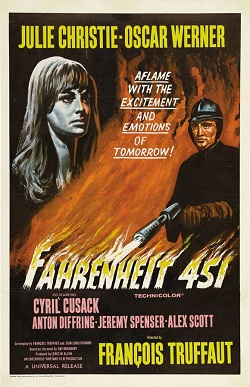 It was Muller's understanding that François Truffaut was dissatisfied with the finished film and Laura confirmed her father had difficulty with the color. It was only his second time to use color in a film. His first films were all small budget black and white New Wave movies and then he went to England to make Farenheit 451 (1966), which was a British production with a lot more money that required color for many reasons. When he came back to France to do The Bride Wore Black, it became clear the film was also going to be in color. Later on as her father progressed in his career, he laid down rules for himself, including how to use color—how to use color in his period movies and how to use color in his more contemporary pieces—but, at the time of The Bride Wore Black, he hadn't quite figured it out. She suspects it was frustrating for him to figure out how to create atmosphere with color. If you think of what are considered to be the great adaptations of Cornell Woolrich, they're primarily in black and white. Femme fatales seem to be more fatale in black and white. That could have been an issue creating tension. For her, The Bride Wore Black is visually distinct from her father's other movies, probably because of those issues.
 It was also Muller's understanding that her father had creative differences with his cinematographer Raoul Coutard who was working at the same time with Godard? In that regard, one of her father's challenges was that the protagonist was supposed to be traveling between one man and the other, as the story moves forward, but unfortunately for budgetary reasons most of the film had to be filmed in one geographic area. So her father and Coutard had to modify the storyline visually, made all the more trickier by the movie being in color, and create the illusion of different landscapes. There was definitely differences of opinion and approach between Coutard and her father.
 Muller noted that The Bride Wore Black was the first Woolrich novel written in what is considered his "black period." Woolrich was a fascinating man. He was a closeted homosexual who lived at the Hotel Marseilles in New York with his mother virtually his whole life and he had absolutely no real experience of the outside world. He was the most socially inept human being imaginable. Despite Woolrich's extraordinary imagination, Muller couldn't imagine a person less like François Truffaut than Cornell Woolrich. Woolrich started writing his noir novels cooped up in his hotel room with The Bride Wore Black being the first of a series. Its structure was extraordinary innovative. Woolrich didn't reveal the motivations of the protagonist until the very end of the book so the reader was going through this whole story—as audiences did with the film—wondering why Julie Kohler was doing what she was doing.
 Truffaut thinks her father decided to move it up a little bit, partly influenced by Hitchcock's understanding of how to manipulate audiences with suspense. When do you bring a flashback into a movie like The Bride Wore Black? A flashback or two was going to be necessary so her father gave much thought to when he would bring them in. Her father eventually agreed that Hitchcock's precept of letting the audience "in on it" early on actually created more suspense than a big revelation at the end. Another Hitchcock touch was that you never saw Jeanne Moreau's character knock on a door or enter a room. A couple of times in the movie she's suddenly just there, without explanation. Truffaut was fairly certain her father stole that from the character of Mrs. Danvers in Hitchcock's Rebecca (1940). Hitchcock made a point of not letting the audience hear Mrs. Danvers' footsteps so that they would be as startled as the protagonist Joan Fontaine when she lifted her glance and Mrs. Danvers was standing there observing her. Obviously, for the character of Mrs. Danvers, this was meant to be spooky. With Julie Kohler, it's meant to be more magical perhaps? She's suddenly in the middle of the scene and there isn't a whole lot of logic to it; the audience needs to accept it as a given.
Muller agreed that her father brought an element of magical realism to the film that compensated for a huge flaw in the original novel, which—not to spoil the plot—but you do wonder at one point how she knows who these men are? That's a crucial point in the story that's never explained. The way her father presented this as a given in the film eliminated the incongruency from the audience's mind. Julie just appears, almost like a supernatural force. There's no realism involved in it.
 Muller asked Truffaut if she had ever met Hitchcock as a child? She hadn't. He wondered because—she may not have noticed as a young girl—but the relationship Hitchcock and her father shared was an intense bond between their two artistries. It fascinated Muller that—while her dad was making this film—his closest confidante was really Hitchcock, who was included in all the correspondence. Her dad was asking him questions all the time. She did attend Hitchcock's funeral under a peculiar set of circumstances.
 Truffaut wanted to point out the unsung actor Serge Rousseau who plays David the groom (who the audience sees for only 10 seconds). He was one of her father's best friends. He was a casting agent, an actors' agent, and often played crucial small roles in her father's movies. Rousseau was actually an excellent actor who had given up on acting himself. He played the character at the end of Baisers volés (Stolen Kisses, 1968) who the audience has seen follow Claude Jade throughout the movie. At the very end he comes up to her sitting on the park bench and declares his love and proposes. He tells her, "Every other relationship is temporary but with me it will be forever." In The Green Room he plays the nemesis of the hero. We only see him in photographs but we hear his name mentioned constantly. So Rousseau played a big role in her father's life by pointing out to him interesting young actors who Truffaut would then watch perform in the theater and often hire for his films.
 There was a story behind the name of the protagonist: Julie Kohler. Julie is a name that her father was fond of, though she never found out why. Kohler was a brand of chocolate that her father liked a lot as a child. He liked that name so much that he used it again in Tirez sur le pianiste (Shoot the Piano Player, 1960) where he named his protagonist Charlie Kohler. Of course, Kohler is also a homonym for colère, which means anger.
Everything Muller has read on this film indicates that it was made at a difficult time in her father's life, which undoubtedly colors his conflicted recollections of the film itself; but, Muller finds the film extraordinary. He's reached a point where he thinks of film noir in thematic terms and for him The Bride Wore Black is a classic thematic example of a film noir. He's impressed with her father's sensitivity to these types of stories, to the work of American writers like Cornell Woolrich and David Goodis (whose novel Down There Truffaut adapted into Shoot the Piano Player, "another classic noir"). The American narrative style tended to be tough, hard-edged and coldhearted; but, her father wasn't like that at all. No one would ever say that François Truffaut was a coldhearted filmmaker. Quite the opposite. He was probably the most humanistic filmmaker of his era. To see him adapt these kinds of stories made them doubly fascinating.
Laura Truffaut concluded by recalling that her father was keen on quoting Jean Renoir: every man has his reasons, which applies to any character in a movie. Muller identified the quote from La Règle du jeu (Rules of the Game, 1939) where, more to the point, the full quote specifies that "the most terrifying thing is that every man has his reasons."
Of related interest: John Goodman's interview with Laura Truffaut for the North Shore News.
{[[' ']]}
']]}
']]}


